
Microsoft Dynamics 365 Business Central for E-Commerce Businesses
Manage inventory, finances, purchasing, sales, and operations in one connected ERP system with Microsoft Dynamics 365 Business Central.
E-commerce businesses need more than an online storefront. As orders, products, suppliers, warehouses, marketplaces, and financial transactions increase, managing operations through spreadsheets and disconnected systems can become difficult.
Microsoft Dynamics 365 Business Central provides an integrated ERP solution that helps e-commerce businesses in the Philippines manage financials, inventory, sales, purchasing, warehouse operations, and business reporting from one platform.
For businesses looking to improve operational visibility and prepare for growth, Business Central provides a centralized system for managing critical business processes.
Looking for Microsoft Dynamics 365 Business Central in the Philippines? Connect with Mustard Seed Systems Corporation for implementation, configuration, training, and support.

Why E-Commerce Businesses Need an ERP System
E-commerce operations can involve multiple sales channels, warehouses, suppliers, payment methods, and customer orders. Without an integrated system, businesses may struggle with:
- Inventory inconsistencies across sales channels
- Manual order and data entry
- Delayed financial reporting
- Difficulty tracking product costs and margins
- Multiple spreadsheets for inventory and purchasing
- Limited visibility across warehouses
- Manual reconciliation of sales transactions
- Challenges managing growing product catalogs
- Difficulty monitoring business performance
An ERP system such as Microsoft Dynamics 365 Business Central brings these processes together so management can work with more consistent and accessible business information.
How Business Central Supports E-Commerce Businesses
1. Centralize Financial Management
Business Central brings accounting and financial operations into one ERP platform.
E-commerce businesses can manage:
- General ledger
- Accounts payable and receivable
- Cash flow
- Budgets
- Financial reporting
- Customer and vendor transactions
- Cost and profitability information
This gives finance teams better visibility into the financial performance of the business.
2. Manage Inventory Across Locations
Inventory is critical for e-commerce businesses. Overstocking ties up capital, while stock shortages can result in missed sales.
Business Central helps businesses manage:
- Product inventory
- Multiple warehouses
- Stock movements
- Item availability
- Reordering
- Purchase planning
- Inventory valuation
- Product costing
With centralized inventory information, businesses can make better purchasing and replenishment decisions.
3. Connect Sales and Operations
E-commerce businesses often need to coordinate sales, inventory, purchasing, fulfillment, and finance.
Business Central provides a central system where teams can access information related to:
Sales → Inventory → Purchasing → Fulfillment → Finance
This helps reduce reliance on separate spreadsheets and disconnected applications.
4. Improve Purchasing and Supplier Management
As product catalogs grow, purchasing becomes more complex.
Business Central can help businesses manage:
- Purchase orders
- Vendors
- Supplier pricing
- Replenishment
- Expected receipts
- Purchase history
- Inventory requirements
Businesses can use purchasing data to support better supplier and inventory decisions.
5. Get Better Business Reporting
E-commerce businesses generate large amounts of operational and financial data.
Business Central provides reporting and analytics capabilities that can help management understand:
- Sales performance
- Inventory levels
- Purchasing activity
- Revenue
- Expenses
- Customer balances
- Product profitability
- Cash flow
Businesses can also connect Microsoft tools such as Excel and Power BI to support reporting and analysis.

Business Central for Multi-Channel E-Commerce
Many Philippine e-commerce businesses sell through more than one channel, such as:
- Company websites
- Online marketplaces
- Social commerce
- Physical stores
- Wholesale channels
- B2B sales
Managing these channels separately can make inventory and financial reconciliation more difficult.
Business Central can serve as a centralized ERP platform for managing core business operations while supporting integration with other business applications and sales channels.
This is especially valuable for growing businesses that need greater control over inventory, purchasing, sales, and financial information.
Business Central for Growing E-Commerce Companies
Business Central is designed to support small and midsize businesses that need an ERP platform capable of supporting business growth.
It can help businesses move away from disconnected tools and establish more structured processes for:
Microsoft Copilot in Business Central
Artificial intelligence is becoming increasingly relevant to e-commerce operations.
Microsoft Copilot in Business Central can help users work with business information and automate selected tasks, helping teams spend less time on repetitive work and more time on analysis and decision-making.
For finance and operations teams, AI capabilities can support areas such as data analysis, content assistance, and business insights, depending on the available Business Central capabilities and configuration.
Learn more about Microsoft Copilot in Business Central and how AI can support modern ERP operations.
Business Central and E-Commerce Inventory Management
One of the biggest challenges for growing online retailers is knowing exactly how much inventory is available.
Business Central helps centralize inventory information across business operations, giving users greater visibility into:
- Available inventory
- Incoming stock
- Product movements
- Warehouse locations
- Purchase requirements
- Item costs
- Inventory valuation
Better inventory visibility can help businesses reduce manual monitoring and make more informed purchasing decisions.

Business Central for E-Commerce in the Philippines
For Philippine e-commerce businesses, an ERP system should support both operational requirements and local business needs.
Microsoft Dynamics 365 Business Central can be configured to support Philippine businesses in areas such as:
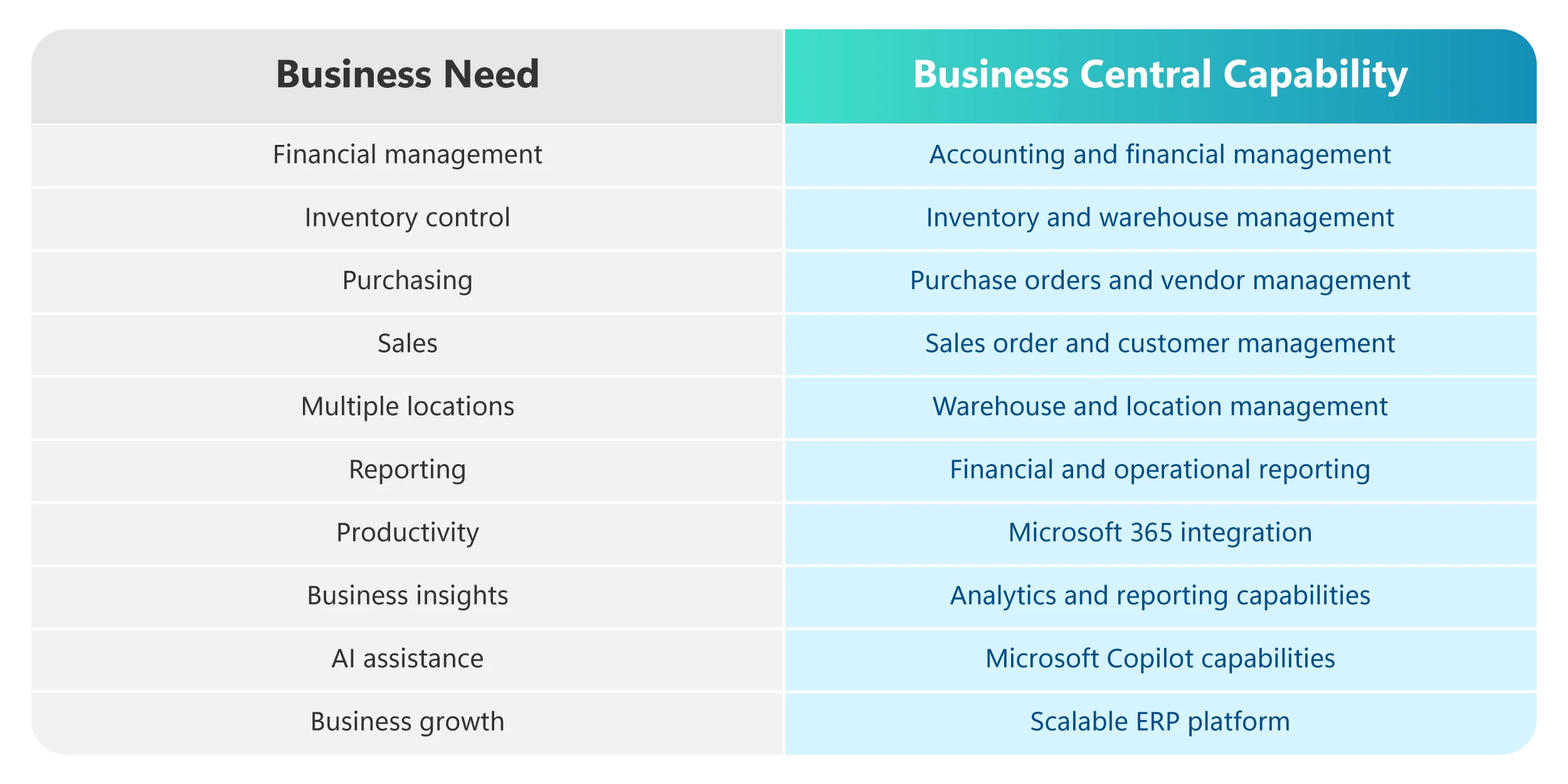
- Accounting and financial management
- Inventory management
- Purchasing
- Sales management
- Business reporting
- Tax-related processes
- Local business requirements
Businesses should work with an experienced Microsoft Dynamics 365 Business Central partner in the Philippines to properly assess requirements, configure the system, migrate data, and implement the appropriate workflows.
Why Choose Mustard Seed Systems for Business Central?
Mustard Seed Systems Corporation helps businesses in the Philippines implement and use business management and ERP solutions.
With 27 years of implementation experience, Mustard Seed Systems provides technology solutions for SMEs and growing businesses across different industries.
Business Central Implementation Experience
Mustard Seed Systems can assist businesses with:
- Business Central consultation
- ERP requirements assessment
- Business process analysis
- System configuration
- Data migration
- Implementation
- User training
- Technical support
- Post-implementation assistance
The goal is to help businesses implement Business Central according to their operational requirements rather than simply deploying software.


A Business Central Partner for Philippine E-Commerce Businesses
Choosing an ERP partner is an important part of an e-commerce implementation.
Mustard Seed Systems understands that businesses may have different requirements depending on their:
- Product catalog
- Sales channels
- Number of warehouses
- Order volume
- Accounting processes
- Supplier network
- Business structure
- Growth plans
Our team can help evaluate your current processes and determine how Microsoft Dynamics 365 Business Central can support your e-commerce operations.
Business Central Features for E-Commerce
When Should an E-Commerce Business Consider Business Central?
Business Central may be worth considering when your e-commerce business is experiencing:
Rapid business growth
Your transaction volume and operations are becoming more complex.
Multiple sales channels
You sell through websites, marketplaces, stores, or B2B channels.
Multiple warehouses
You need better visibility across different inventory locations.
Manual accounting processes
Finance teams spend too much time consolidating data.
Inventory challenges
Your team relies heavily on spreadsheets to track stock.
Disconnected systems
Different departments use separate applications that do not share information effectively.
Limited management visibility
Leadership needs faster access to financial and operational information.

Send us a Message
For more information or inquiry about our products and services, kindly fill out the form below.
Get in Touch
