No featured image available for this article.
Managing Multiple Companies? Understanding Multi-Entity Accounting and How NetSuite Helps
Managing multiple companies, subsidiaries, or business locations can make financial reporting more complicated. Each entity may have its own transactions, bank accounts, currencies, tax requirements, and accounting records. Without a connected accounting system, consolidating financial data and maintaining accurate reports can become time-consuming.
Multi-entity accounting helps businesses manage the financial activities of multiple legal entities within a coordinated accounting environment. With Oracle NetSuite, businesses can manage subsidiaries, consolidate financial information, and gain better visibility into their overall financial performance.
This guide explains what multi-entity accounting is, its common challenges, and how NetSuite supports businesses managing multiple companies.
What Is Multi-Entity Accounting?
Multi-entity accounting is an accounting approach that allows businesses to manage the financial records of multiple legal entities within a coordinated accounting system.
Each company or subsidiary can maintain its own:
- General ledger and chart of accounts
- Income and expense records
- Accounts payable and receivable
- Bank accounts and financial transactions
- Tax and compliance records
- Financial statements
At the same time, the parent company can access consolidated financial information to understand the performance of the entire business group.
Multi-Entity Accounting vs. Traditional Accounting
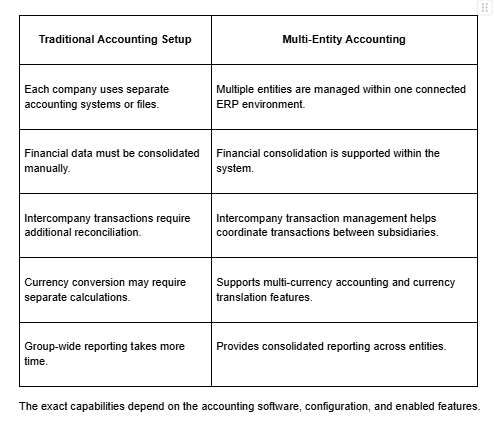
Common Challenges of Managing Multiple Companies
As businesses expand through new subsidiaries, acquisitions, or international operations, accounting teams may face several challenges.
How NetSuite Helps Businesses Manage Multiple Companies
NetSuite OneWorld is designed to support organizations managing multiple subsidiaries, business units, and international operations.
Its multi-subsidiary capabilities help businesses manage financial processes across entities while maintaining visibility into consolidated business performance.
Here are several ways NetSuite supports multi-entity accounting.
1. Manage Multiple Subsidiaries in One ERP System
NetSuite OneWorld supports the management of multiple subsidiaries within a structured organizational hierarchy.
Businesses can configure subsidiary records, currencies, accounting settings, and financial processes according to their organizational requirements.
This allows finance teams to manage entity-level accounting while supporting group-wide reporting.
Example:
A Philippine-based company operates subsidiaries in Singapore, Malaysia, and the United States. Instead of maintaining completely separate ERP environments, the business can use NetSuite OneWorld to organize its subsidiaries within one system.
2. Consolidate Financial Information Across Entities
One of the key benefits of multi-entity accounting is the ability to view financial information across subsidiaries.
NetSuite OneWorld supports financial consolidation, including consolidated reporting and intercompany elimination processes.
This helps finance teams prepare reports that reflect the financial position and performance of the business group.
Business benefit: Management can review consolidated financial information without relying entirely on manually combined spreadsheets.
3. Support Multi-Currency Accounting
Businesses operating in multiple countries may need to manage transactions and financial statements in different currencies.
NetSuite supports foreign currency management and currency translation capabilities. Its Multi-Book Accounting feature can also support different base currencies for subsidiaries across accounting books, subject to configuration and feature requirements.
This can help businesses manage:
- Foreign currency transactions
- Subsidiary-specific base currencies
- Currency translation for reporting
- Financial records across international operations
Example: A Philippine parent company with a US subsidiary can manage financial records using their respective currencies while supporting consolidated reporting.
4. Manage Intercompany Transactions
Intercompany transactions occur when two companies within the same business group conduct business with one another.
Examples include:
- Sales between subsidiaries
- Intercompany purchases
- Shared operational expenses
- Loans and reimbursements
- Inventory transfers between entities
NetSuite provides intercompany transaction management features, including intercompany journal entries and elimination processes.
These capabilities help businesses record transactions between subsidiaries and support accurate consolidated financial reporting.
5. Support Different Accounting Books
Some organizations need to maintain financial records according to different accounting requirements, reporting purposes, or accounting standards.
NetSuite Multi-Book Accounting allows businesses to maintain multiple sets of accounting records based on a single set of real-time financial transactions.
Depending on the configuration, accounting books may use different:
- Charts of accounts
- Currencies
- Accounting rules
- Financial reporting requirements
NetSuite's documentation states that Multi-Book Accounting is available in NetSuite OneWorld and supports multiple accounting books for qualifying use cases.
Why this matters: Businesses with different financial reporting requirements may be able to manage those requirements without maintaining entirely separate accounting systems.
6. Improve Visibility Into Financial Performance
NetSuite provides reporting capabilities that allow finance teams to review financial information by subsidiary and accounting book.
Standard reports can include accounting book filters, while consolidated reporting features support group-level financial analysis.
This can help management review:
- Revenue by subsidiary
- Operating expenses
- Profitability across entities
- Consolidated financial performance
- Intercompany balances
Practical Example: How Multi-Entity Accounting Works in NetSuite
Consider a business group with the following structure:
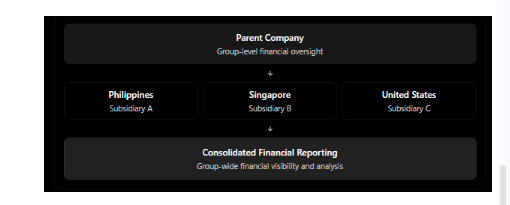
Without Multi-Entity Accounting
Each subsidiary may use separate spreadsheets or accounting software. The parent company then collects financial reports, converts currencies, reconciles intercompany balances, and prepares consolidated statements.
With NetSuite OneWorld
Each subsidiary can maintain its own financial records within the configured NetSuite environment, while the parent company can access consolidated financial reporting and supported intercompany processes.
This can reduce duplicated data handling and provide a more coordinated approach to managing group finances.
When Should a Business Consider Multi-Entity Accounting Software?
Multi-entity accounting software may be worth evaluating if your business:
- Operates multiple subsidiaries or legal entities.
- Has expanded into other countries.
- Regularly prepares consolidated financial statements.
- Manages frequent intercompany transactions.
- Uses different currencies across entities.
- Relies heavily on spreadsheets for group-level reporting.
- Experiences delays in closing monthly or quarterly financial records.
- Needs better visibility into subsidiary-level and consolidated performance.
The right solution depends on the organization's size, accounting requirements, existing systems, and operational complexity.
Is NetSuite Suitable for Businesses With Multiple Subsidiaries?
NetSuite OneWorld is designed for organizations that need multi-subsidiary management, financial consolidation, multi-currency capabilities, and broader financial control across business entities.
However, businesses should evaluate their specific requirements before implementation, including:
- Number of subsidiaries and locations.
- Countries and currencies involved.
- Intercompany transaction volume.
- Financial reporting and accounting requirements.
- Existing accounting and ERP systems.
- Integration, migration, and compliance needs.
A proper assessment helps determine whether NetSuite's capabilities and configuration align with the organization's business structure.
Why Choose Mustard Seed Systems Corporation for NetSuite Solutions?
Mustard Seed Systems Corporation (MSSC) is a business technology solutions provider in the Philippines with 27 years of technology implementation experience, helping businesses identify and implement software solutions aligned with their operational and financial requirements. With expertise in ERP and business technology solutions, MSSC supports businesses seeking better ways to manage accounting, financial reporting, and business operations. Through its presence in Metro Manila, Cavite, Dagupan, Cebu, Bacolod, Iloilo, Cagayan de Oro, and Davao, MSSC provides technology solutions and support to businesses across the Philippines.
Send us a Message
For more information or inquiry about our products and services, kindly fill out the form below.
Get in Touch
