
BIR CAS E-Invoicing Philippines: Is Your Accounting System Ready?
Is your Computerized Accounting System (CAS) ready for BIR e-invoicing?
Under the current BIR rules, certain covered taxpayers using Computerized Accounting Systems (CAS), Computerized Books of Accounts (CBA) with electronic invoicing, and other invoicing software are required to comply with the applicable electronic invoicing requirements by December 31, 2026.
If your business uses a CAS or accounting software to generate invoices, now is the time to review whether your current system can support BIR CAS e-invoicing requirements.

What Is BIR CAS E-Invoicing?
BIR CAS e-invoicing refers to the use of a computerized accounting or invoicing system that can generate the required invoice information and support the applicable electronic invoicing and reporting requirements of the Bureau of Internal Revenue (BIR).
For businesses using a CAS, e-invoicing preparation involves reviewing how invoices are generated, what data the system captures, how invoice information is stored, and whether the system can support applicable electronic reporting and transmission requirements.
Having a CAS does not automatically mean that a business is ready for BIR e-invoicing. The system's functionality and configuration should be assessed based on the requirements applicable to the business.
Who Should Review Their BIR CAS E-Invoicing Readiness?
Businesses should review their accounting and invoicing systems if they are currently using:
- Computerized Accounting Systems (CAS)
- Computerized Books of Accounts (CBA)
- ERP systems
- Accounting software
- Invoicing software
- Excel-based invoicing
- Word-based invoices
- Manually prepared invoices
- PDF-based invoicing processes
The key question is:
Can your current CAS or accounting system generate, manage, and support the electronic invoice data and reporting requirements applicable to your business?

What Should Businesses Check for BIR CAS E-Invoicing?
1. CAS Invoice Generation
Check whether your Computerized Accounting System can generate invoices containing the information required under applicable BIR rules.
2. Electronic Invoice Data
Review whether your CAS can generate and manage the required electronic invoice data.
3. Electronic Reporting
Determine whether your accounting system can support applicable BIR electronic reporting and transmission requirements.
4. Sales and Accounting Records
Check whether sales transactions, customer information, invoices, and accounting records are properly captured within your system.
5. Manual Encoding
Identify processes that still require manual encoding, duplicate data entry, spreadsheets, or separate invoicing tools.
6. CAS Configuration
If your current CAS can support the applicable requirements, determine whether additional configuration, integration, or implementation work is needed.
7. BIR E-Invoicing Readiness
Review your overall system setup against the BIR requirements that apply to your taxpayer classification and business transactions.

BIR CAS E-Invoicing Deadline: December 31, 2026
December 31, 2026 is an important compliance date under the current BIR transitory provisions for certain covered taxpayers, including taxpayers using CAS, CBA with electronic invoicing, and other invoicing software.
Businesses should not wait until the deadline to determine whether their existing accounting and invoicing system can support the applicable requirements.
Starting the assessment early gives businesses time to:
✓ Review their current CAS
✓ Identify system limitations
✓ Review invoice data requirements
✓ Determine configuration requirements
✓ Evaluate integration needs
✓ Plan implementation
✓ Train users
Can Oracle NetSuite Support BIR CAS E-Invoicing?
Oracle NetSuite is a cloud-based ERP platform with accounting, financial management, sales, invoicing, and reporting capabilities.
For businesses evaluating their CAS or looking for an ERP system, NetSuite can provide a centralized platform for:
✓ Accounting and financial management
✓ Sales transactions
✓ Customer records
✓ Invoice generation
✓ Accounts receivable
✓ Accounts payable
✓ Financial reporting
✓ Multi-company operations
✓ Multi-currency transactions
Businesses can assess how NetSuite can be configured and implemented to support their accounting, invoicing, reporting, and applicable Philippine tax requirements.
Important: Using NetSuite does not automatically make a business compliant with all BIR CAS or e-invoicing requirements. Proper system configuration, implementation, and processes are required based on the company's specific requirements.
Oracle NetSuite ₱699K Package for SMEs
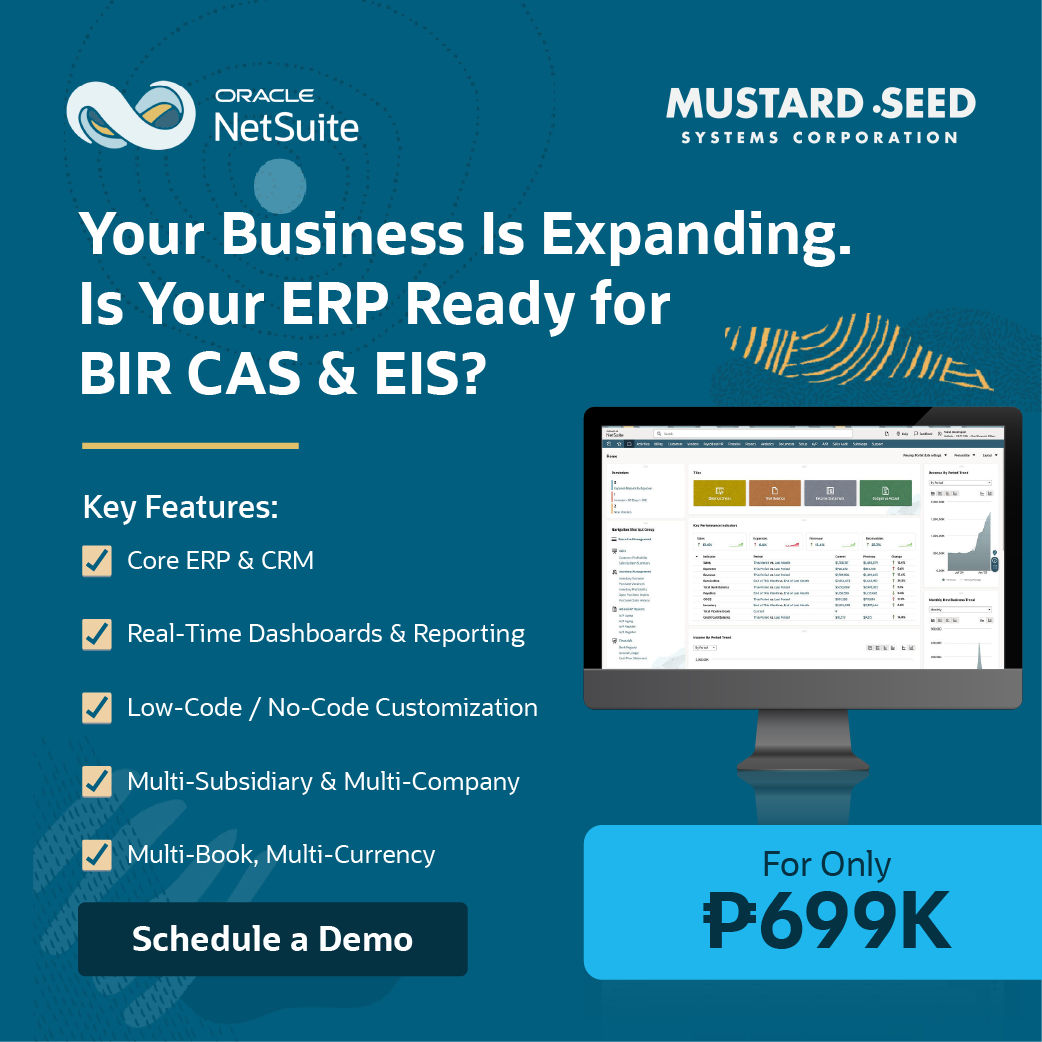
For SMEs looking for a new accounting and ERP system, Mustard Seed Systems Corporation offers an Oracle NetSuite package for ₱699,000.
The ₱699K NetSuite package for SMEs includes:
- NetSuite licenses
- Implementation
- Learning resources
- Basic after-sales support
The package gives SMEs an option to evaluate a cloud-based ERP platform for accounting, invoicing, financial management, and other business processes.
A requirements assessment should be completed to determine the appropriate NetSuite configuration and implementation scope for the business.
Why Choose Mustard Seed Systems for BIR CAS E-Invoicing?
Mustard Seed Systems Corporation (MSSC) is a business technology solutions provider in the Philippines with 27 years of technology implementation experience.
MSSC can assist businesses with their NetSuite implementation and accounting system requirements, including:
✓ Requirements assessment
✓ NetSuite implementation
✓ System configuration
✓ Data migration
✓ User training
✓ Accounting and business process setup
✓ After-sales support
MSSC supports businesses across the Philippines through its presence in Metro Manila, Cavite, Dagupan, Cebu, Bacolod, Iloilo, Cagayan de Oro, and Davao.
For SMEs and growing businesses reviewing their existing CAS, MSSC can help assess their accounting and invoicing requirements and determine whether an ERP platform such as NetSuite fits their business processes.

Prepare for BIR CAS E-Invoicing
If your business uses a Computerized Accounting System (CAS), accounting software, ERP, Excel, Word, or manually prepared invoices, review your current invoicing process before the December 31, 2026 deadline.
For SMEs evaluating a new ERP system, the ₱699K Oracle NetSuite package from Mustard Seed Systems includes licenses, implementation, learning resources, and basic after-sales support.
Schedule a Demo with Mustard Seed Systems to discuss your CAS, accounting, and BIR e-invoicing requirements.
Send us a Message
For more information or inquiry about our products and services, kindly fill out the form below.
Get in Touch
